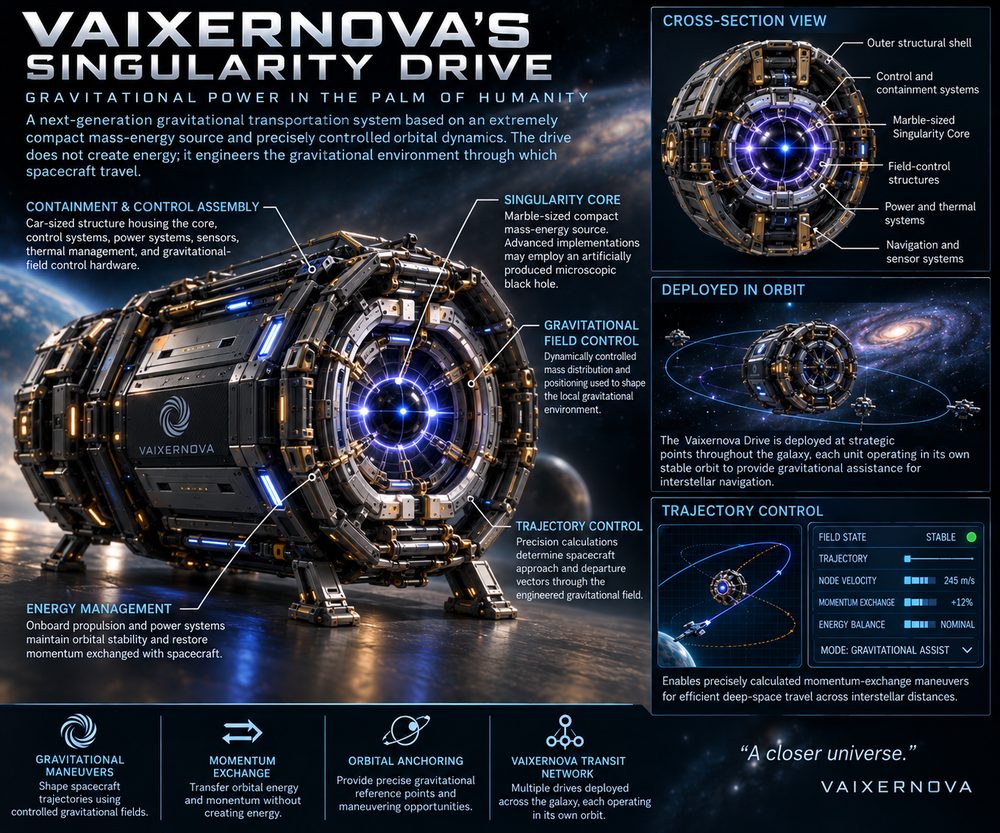
The Vaixernova's Singularity Drive is a theoretical deep-space transportation system based on the controlled use of extremely compact and massive objects to manipulate spacecraft trajectories through gravitational interaction.
A Theoretical Framework for Gravitational Deep-Space Navigation
Introduction
The Vaixernova’s Singularity Drive is a theoretical deep-space transportation system based on the controlled use of extremely compact and massive objects to manipulate spacecraft trajectories through gravitational interaction.
The fundamental principle is not the creation of gravity from nothing, nor the production of energy without an energy source. Instead, the system uses the gravitational curvature of spacetime produced by concentrated mass-energy and combines it with precisely controlled orbital motion.
In its mature form, a Vaixernova Singularity Drive would function as an artificial gravitational navigation and acceleration system, allowing spacecraft to exploit gravitational assists, momentum exchange, and carefully calculated trajectories over distances where conventional propulsion would otherwise require enormous quantities of propellant.
The technology described here assumes a future civilization capable of manipulating matter and energy at levels far beyond current engineering capabilities. However, the underlying framework is constrained by established principles of general relativity, quantum mechanics, and conservation of energy and momentum.
1. The Gravitational Principle
According to general relativity, mass and energy determine the curvature of spacetime. A sufficiently concentrated mass therefore produces a correspondingly strong gravitational field.
The Vaixernova Drive exploits this relationship by placing an extremely large quantity of mass-energy into a controlled and compact configuration.
The resulting gravitational field becomes an engineered component of the spacecraft's navigation environment.
The drive does not generate gravity independently of matter. Instead, it creates a deliberately positioned gravitational source whose properties can be incorporated into spacecraft trajectory calculations.
The greater the mass concentration and the smaller the distance from the spacecraft, the stronger the gravitational interaction becomes.
2. The Compact Mass Core
The central component of the system is the Singularity Core: an extremely compact mass-energy source capable of producing a substantial gravitational field within a controlled region of space.
Several technological implementations could potentially exist as civilization advances.
The least extreme implementation could utilize an enormous quantity of naturally occurring matter assembled into a compact structure. Asteroidal or planetary material could, in principle, provide the required mass.
A more advanced implementation could utilize artificially produced ultra-dense matter whose stability and properties remain beyond present engineering capabilities.
At the technological extreme, the Singularity Core could consist of an artificially produced microscopic black hole.
The latter configuration would not require the black hole to be physically "contained" in the conventional sense. Its position and trajectory could instead be controlled through external gravitational, electromagnetic, and propulsion systems acting upon the surrounding infrastructure or associated mass distribution.
The choice of core technology would therefore depend on the technological maturity of the civilization constructing the system.
3. Gravitational Field Engineering
The gravitational environment surrounding the Singularity Core does not need to remain perfectly spherical.
A Vaixernova Drive can theoretically incorporate multiple independently controlled masses surrounding the primary core.
These secondary masses form a dynamically controlled gravitational architecture.
By changing their positions and orbital velocities, the system can alter the gravitational gradients experienced by approaching spacecraft.
This creates a form of gravitational field engineering.
The system does not require the ability to switch gravity on and off. Instead, it changes the geometry and motion of the mass producing the gravitational field.
Advanced computational systems continuously calculate the gravitational state of the drive and determine the trajectories required to achieve a desired spacecraft departure vector.
4. The Momentum-Exchange Principle
A stationary gravitational source cannot provide unlimited energy to a spacecraft.
The Vaixernova Drive therefore relies on momentum exchange.
A spacecraft approaching a moving gravitational source can exchange kinetic and orbital energy with that source. This is the same fundamental principle that allows spacecraft to gain or lose velocity during gravitational-assist maneuvers around planets.
In a Vaixernova system, however, the gravitational source itself can be an engineered object whose trajectory, mass distribution, and velocity are deliberately controlled.
The spacecraft can therefore enter a precisely calculated trajectory around the node and depart with a substantially different velocity vector.
The energy transferred to the spacecraft originates from the kinetic or orbital energy of the gravitational node.
The node itself experiences an opposing change in momentum and energy.
If required, the node's orbital energy can subsequently be restored through an external propulsion or energy system.
This preserves conservation of energy and momentum.
5. The Visernova Transit Node
A complete Vaixernova Drive is not necessarily a single isolated machine.
Multiple drives can be deployed throughout a planetary system to form a Visernova Transit Network.
Each node occupies a carefully calculated orbit and provides a predictable gravitational environment.
A spacecraft traveling through the network can perform a sequence of gravitational maneuvers:
Node → gravitational maneuver → Node → gravitational maneuver → Node
Instead of carrying enough propellant to perform every major velocity change independently, the spacecraft uses the gravitational infrastructure surrounding it.
The result is analogous to a transportation network in which the infrastructure provides the environment required for efficient movement.
The spacecraft remains physically within normal space throughout the process.
6. Orbital Energy Management
The long-term operation of a Visernova network requires careful management of the energy and momentum exchanged between spacecraft and gravitational nodes.
Every acceleration obtained by a spacecraft corresponds to an opposing change somewhere within the system.
A node can therefore gradually lose orbital energy as spacecraft use it for gravitational assists.
To maintain the network, the node can be equipped with an independent propulsion system.
Possible future propulsion systems could include extremely high-efficiency fusion propulsion, beamed-energy propulsion, advanced electric propulsion, or other technologies compatible with known conservation laws.
The energy source of the overall transportation system therefore remains external.
The gravitational system acts as a momentum-transfer mechanism, not an energy-creation mechanism.
7. The Singularity Configuration
The most advanced form of the Vaixernova Drive could employ an artificial microscopic black hole as its primary gravitational source.
A black hole is not a theoretical violation of known physics. Black holes are predicted by general relativity and observational evidence strongly supports their existence.
The engineering challenge would be the artificial production and management of a sufficiently small black hole.
A microscopic black hole would possess an extremely compact gravitational source while potentially allowing the surrounding infrastructure to remain at comparatively large distances.
The gravitational behavior outside the black hole would still be governed by general relativity.
The drive would therefore not require an artificial law of gravity.
It would require the ability to manipulate one of the most extreme gravitational objects permitted by known physics.
This represents one of the highest technological thresholds of the Vaixernova system.
8. Control and Navigation
Because the gravitational field surrounding the drive can become extremely strong, navigation must be extraordinarily precise.
The drive's control system continuously monitors:
- spacecraft position
- spacecraft velocity
- spacecraft mass
- approach vector
- desired departure vector
- gravitational conditions
- node position
- node velocity
- surrounding planetary and stellar masses
- accumulated momentum exchange
The resulting calculations determine the spacecraft's optimal trajectory through the gravitational field.
The spacecraft does not need to "steer against" the gravity of the node in the conventional sense.
Instead, its trajectory is selected so that gravity performs the desired portion of the maneuver.
The spacecraft essentially follows a deliberately engineered path through curved spacetime.
9. Deep-Space Applications
A mature Vaixernova network could support several forms of deep-space transportation.
Interplanetary Transportation
Nodes positioned throughout a planetary system could provide repeated gravitational-assist opportunities, substantially reducing the propellant requirements of long-distance spacecraft.
High-Velocity Departure
A spacecraft could approach a moving node and use momentum exchange to obtain a higher departure velocity before leaving the planetary system.
Orbital Transfer
Nodes could be positioned to assist transfers between planets, moons, asteroids, and orbital habitats.
Navigation
Because the nodes occupy precisely known positions and generate measurable gravitational fields, they could also function as extremely accurate navigational reference points.
Interstellar Infrastructure
At sufficiently advanced technological levels, civilizations could establish gravitational nodes around multiple stars.
The nodes would not make interstellar travel instantaneous. Instead, they would provide infrastructure for progressively more efficient acceleration and deceleration.
10. Physical Limitations
The Vaixernova Drive does not eliminate the fundamental limitations imposed by physics.
It cannot create energy without an energy source.
It cannot obtain unlimited acceleration from a stationary gravitational field.
It cannot automatically exceed the speed of light.
It cannot eliminate momentum conservation.
Every velocity increase must correspond to an exchange of energy and momentum with another physical system.
The purpose of the technology is therefore not to circumvent these principles.
Its purpose is to engineer the physical environment so that spacecraft can exploit them with extraordinary efficiency.
11. Technological Requirements
The construction of a functional Vaixernova Drive would require capabilities vastly beyond present civilization.
Among the required advances would be:
- Extremely large-scale mass assembly.
- Advanced manipulation of ultra-dense matter.
- Precise gravitational and orbital control.
- Extremely high-energy propulsion systems.
- Autonomous gravitational trajectory computation.
- Advanced materials capable of operating near extreme gravitational environments.
- Large-scale energy generation and storage.
- Potentially, artificial compact-object or black-hole production.
- Extremely precise astronomical positioning and navigation.
- Infrastructure capable of operating over astronomical distances.
None of these capabilities currently exists at the required scale.
Their absence, however, does not by itself establish that the underlying concept violates known physical law.
12. Theoretical Status
The Vaixernova’s Singularity Drive should therefore be regarded as a speculative future technology rather than a presently demonstrated technology.
Its foundational principles are derived from established physics:
- mass-energy produces gravitational effects;
- spacetime curvature governs gravitational motion;
- gravitational assists permit momentum and energy exchange;
- orbital systems contain kinetic and potential energy;
- energy and momentum are conserved;
- compact objects can produce extremely strong gravitational fields;
- black holes are permitted by general relativity.
The major uncertainties concern the technological ability to manipulate matter, energy, and compact gravitational sources at the required scale.
The central proposition of the Vaixernova Drive is consequently not that humanity can manufacture gravity or circumvent the laws of physics.
It is that a sufficiently advanced civilization could potentially engineer its gravitational environment to such a degree that gravity itself becomes part of its transportation infrastructure.
Conclusion
The Vaixernova’s Singularity Drive represents a theoretical approach to deep-space transportation in which gravitational fields are treated not merely as naturally occurring phenomena but as engineered infrastructure.
Rather than carrying all of the energy required for acceleration aboard each spacecraft, a civilization could construct massive gravitational nodes whose positions, velocities, and mass distributions are deliberately controlled.
Spacecraft would then navigate through these engineered gravitational environments, exchanging momentum and energy with the nodes according to the same physical principles governing natural gravitational assists.
The most advanced implementations could employ extraordinarily compact objects, potentially including artificial microscopic black holes.
The resulting system would not constitute a violation of known physics.
It would represent something considerably more ambitious:
the transition from traveling through a naturally occurring gravitational environment to deliberately engineering the gravitational environment through which civilization travels.